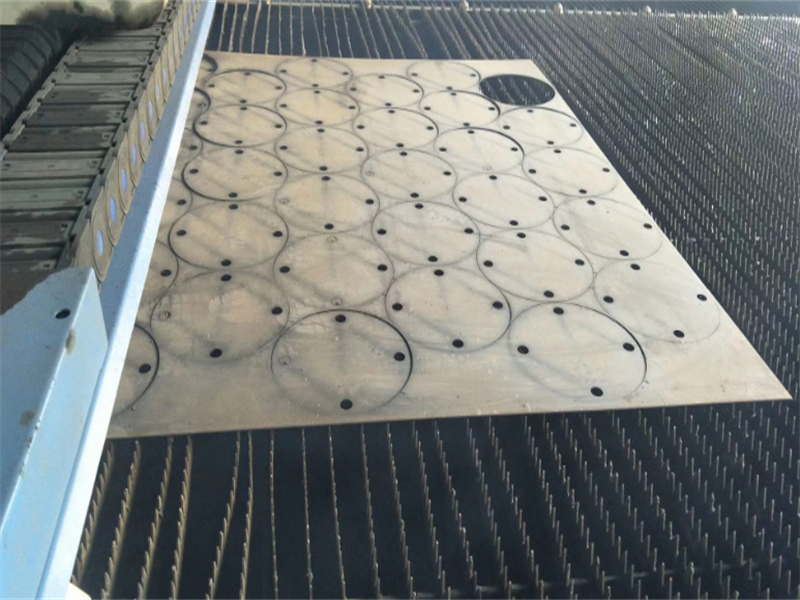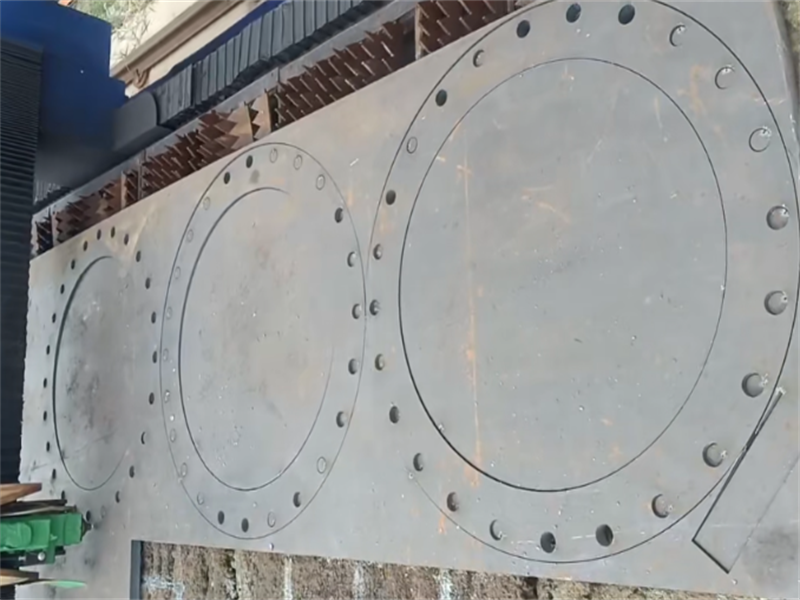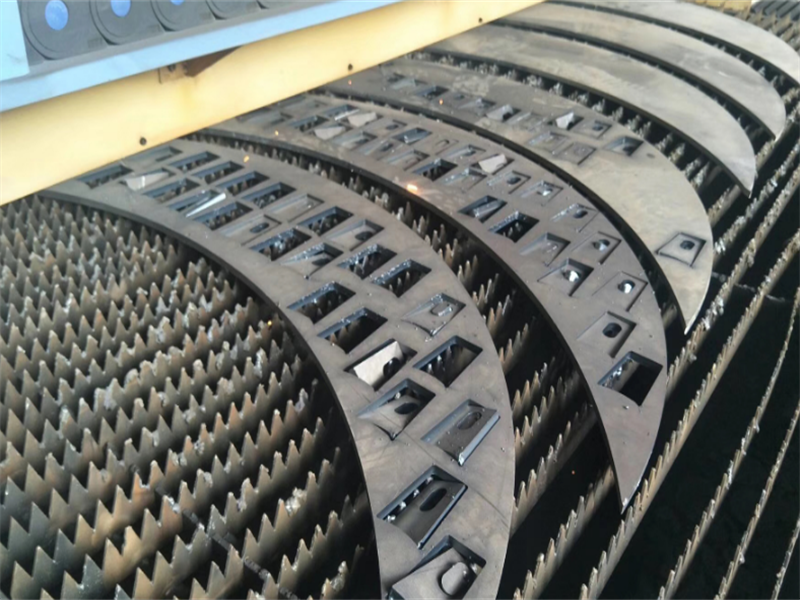
Laser cutting of steel plates,Metal sheet laser cutting is carried out to achieve the specified dimensions.
Metal laser cutting is customized.Metal sheet laser cutting is a processing method that
precisely separates metal materials according to the predetermined contour using a high-energy laser beam.
To achieve the specified size of cutting, the following general steps need to be followed:
1. Material Preparation: Select metal sheets that meet the requirements (such as carbon steel, stainless steel, aluminum alloy, etc.),
confirm the thickness, surface condition and flatness of the sheets.
Place the sheets on the worktable of the laser cutting machine,
fix them using fixtures or vacuum suction devices to prevent displacement during the cutting process.
2. Drawings and Parameter Settings:
In the computer-aided design (CAD) software, draw the two-dimensional contour diagram of the required part,
mark the precise dimensions (such as length, width, hole diameter, etc.).
Import the drawings into the numerical control system of the laser cutting machine,
and set the laser power, cutting speed, auxiliary gas type
(e.g. oxygen, nitrogen) and gas pressure, focus position, etc. as the process parameters according to the material and thickness of the sheet.
3. Cutting Execution: Start the equipment,
and the laser head moves along the preset path.
The laser beam is focused by the focusing lens onto a tiny spot,
causing the metal to partially melt, vaporize, and be blown away by the airflow along with the slag, forming a cutting seam.
During the cutting process, the equipment automatically monitors the laser power,
the alignment of the nozzle, and the temperature of the sheet,
ensuring that the cutting seam width is uniform and there is no slag hanging at the edge.
4. Dimension Inspection: After the cutting process is completed, use a vernier caliper, micrometer,
or a three-coordinate measuring instrument to conduct dimension checks on the finished product.
The key measurements include the linear dimensions of the critical contours, the diameter of the circular holes,
the radius of the arcs, and the perpendicularity.
Confirm whether the results are within the tolerance range specified in the drawing (e.g., ±0.1mm).
If there are deviations, adjust the cutting parameters or check the fixation status of the sheet material and re-cut.
5. Post-processing:
The cutting burrs and oxide layers are ground or acid-washed.
For parts with high precision requirements, secondary fine processing (such as drilling and tapping) can be carried out.
Finally, the qualified parts are classified and stored by batches.
This process is applicable to both mass production and single-piece customization.
By controlling the stability of the laser cutting process,
it is possible to repeatedly produce metal sheet components of specified dimensions.
China Laser cutting of steel plates